
Creativity, Craft & Community at Moygownagh Rambling House
/Thursday, April 30th
Tying the Knot is Not as Simple as One Would Think!
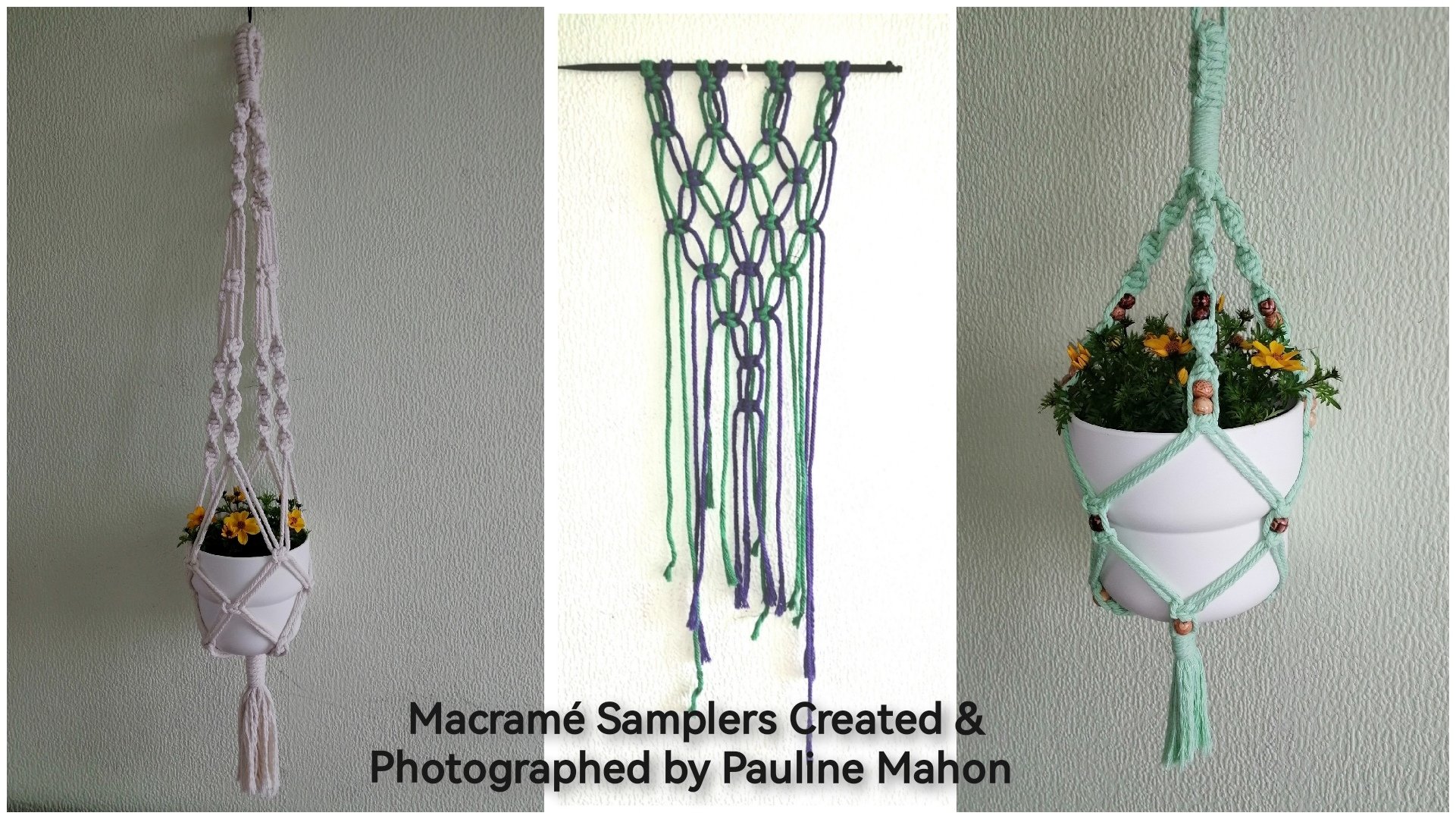
Macramé is a skilled craft involving the manipulation of cords through a combination of knots to create intricate designs for wall hangings, hammocks, belts, bags and many other decorative household accessories.
The word macramé derives from the Arabic miqrama, meaning “fringe”, and was originally used as a decorative knotting technique to finish loose threads on hand-loomed fabrics. The origins of the textile art trace back to thirteenth-century Arabia.
In Turkey, macramé is known as makrama, meaning towel or napkin, and is associated with the “Turk’s head knot” — a circular knot resembling a turban. This knot remains popular in coaster and jewellery making.
Traditionally, macramé was used for practical purposes such as creating bags for transporting goods and for the making and repair of fishing nets. Turkish sailors believed items incorporating the Turk’s head knot, including armbands and turbans, brought luck and ensured a safe passage home from the sea.
Chinese forms of decorative knotting date back to the third century, with the “mystic knot” symbolising the cycle of life due to its continuous design without a visible beginning or end. It is also regarded as a symbol of good fortune and spirituality.
Macramé experienced a resurgence during the 1970s through the American Boho and hippy movement, eventually becoming part of mainstream interior design and fashion throughout Europe and Ireland.
An understanding of the five basic knots — although there are many more — and their interchangeable use allows crafters to create unique and imaginative pieces.
Macramé made its debut in Moygownagh tonight. Fun and banter carried us along as we assembled and completed our craft project over a two-night tutorial. While macramé can be daunting at first, it is also a very rewarding hobby, completed entirely by hand without the use of tools.
A sincere thank you to our tutor, Jamie Morgan, for her time and patience in guiding our enthusiastic Rambling House participants through the basics of this ancient craft. We also appreciated her thoughtful gift of a plant pot and beautiful plant for each participant to display in their newly-created macramé hanging basket.
Monday, May 11th
Fresh Flower Wreaths
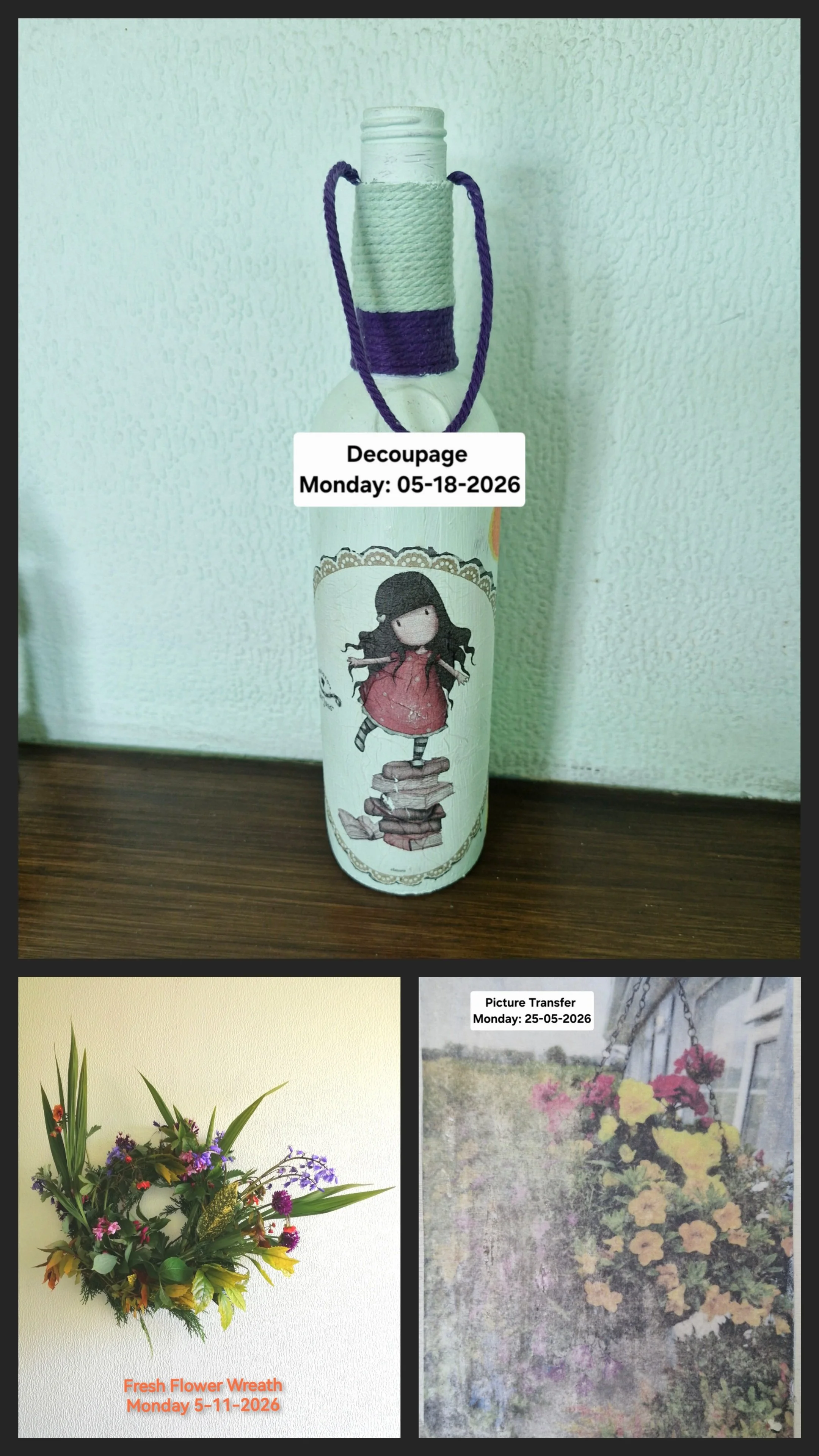
Prior to becoming a member of Moygownagh’s Rambling House Group, I would never have considered craft work. However, after enjoying reasonable success with a variety of projects using different textured materials, I decided to move out of my comfort zone and join a free three-week morning craft course at Crossmolina Civic Centre.
Our first project involved creating a seasonal fresh flower wreath using foliage and flowers grown in our own gardens. It was an enjoyable and interesting assignment, although perhaps slightly counterproductive in the long term, as freshly-cut flowers fade rather quickly once removed from water.
Unlike my sturdy Christmas wreath, however, which survived remarkably well. Due to a prolonged bout of flu in January, I was unable to retrieve it from the church gallery after the festive season. After several searches — including a browse through the rubbish bins — we were eventually reunited one Sunday in May, some twenty weeks later, when the wreath emerged from a small cupboard at the back of the church looking almost as fresh and green as the night it had been assembled.
Monday, May 18th
Discovering Decoupage
Adventure number two, in my humble opinion, was perhaps better suited to people several generations younger than myself, though it still required skill, patience and a deft hand with the scissors.
Decoupage originated in eastern Siberia as tomb art and by the twelfth century had become a fashionable upper-class decorative art form. The technique involves using cut-outs from greeting cards, newspapers or decorative serviettes to artistically decorate boxes, bottles, wooden items and glassware.
For my own experiment, I selected a glass bottle. First, the surface had to be primed with a coat of emulsion paint. I even added a handle — which was entirely unnecessary, but somehow felt appropriate at the time!
After carefully selecting and trimming my chosen image, several layers of glue were applied before my new masterpiece was ready to display.
Thursday, May 21st
An Evening with David Hicks
Published author, architectural historian and direct descendant of the Knox-Gore family of Rappa Castle, Mr David Hicks delivered a fascinating lecture supported by rare documents, historical records and photographic evidence of many important historic residences throughout County Mayo and Ireland.
Among the buildings discussed were Stonehall, Glenmore and Owenmore (Millbrook) in Moygownagh — all dating from pre-Famine times and each with its own unique story. Some remain occupied residences, others have fallen into dereliction, while some continue as homes combined with business premises.
Mr Hicks is deeply involved in documenting Ireland’s built heritage and highlighting the preservation needs of vulnerable historic structures through his writings, photography and lectures. His work also includes collaboration with organisations such as the Georgian Society and the Office of Public Works.
Moygownagh Rambling House Group would like to sincerely thank Mr Hicks for an entertaining and informative evening. We also thank the large audience who attended and helped make the “Connect Café” presentation such a success.
Monday, May 25th
Exploring Picture Transfer Art
Our third and final creative challenge involved the art of Picture Transfer, a technique dating back to the fresco transfers of the fourteenth-century Renaissance.
Using a laser-printed image — such as a sunset, animal scene or family photograph — a layer of Mod Podge glue is applied both to the image surface and the receiving material. The image is then placed face-down and carefully smoothed to remove bubbles or creases.
Once completely dry, the backing paper is gently moistened and peeled away, magically revealing the transferred translucent image beneath. The final step involves sealing the artwork with layers of clear varnish.
Many thanks to our three tutors for their patience, guidance and encouragement throughout these enjoyable and creative workshops.